2026-03-21
heavy metal
Noise. (1981) 🍁
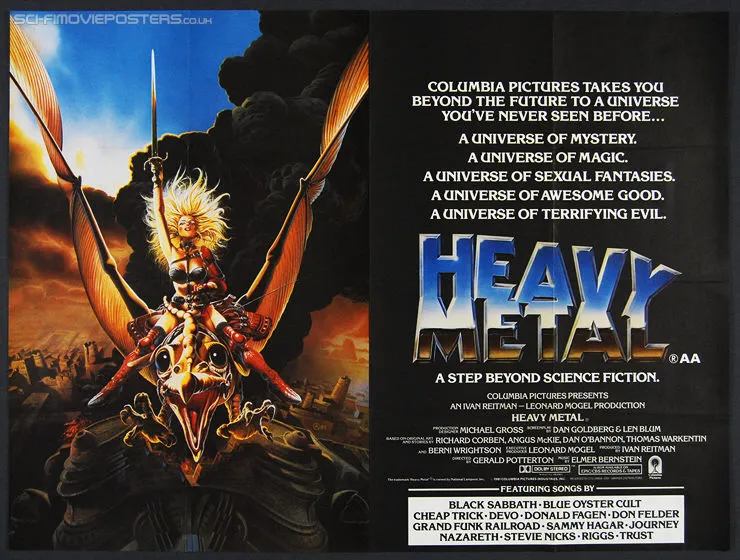
I made my ex-girlfriend watch this movie with me, back-to-back with Interstellar.
It was probably only my 6th time watching Heavy Metal. 2nd time for Interstellar.
Her mom said that she remembered it was the most boring shit from the 80's, and it was only the second year in.
Ouch.
Yes, Heavy Metal is a very slow-paced anthology, overly violent and sexualized, and other things that are reminiscent of a simpler, although scarier and creepier, time of life.
But that's what the 80's is all about when my generation thinks of the 80's, beyond the songs, beyond the positive aesthetics.
The art style of Heavy Metal has a special place in my heart surrounding the core of what's retro. And I love retro horror and weird works of art like this.
Of course Heavy Metal has their own article covering their own history. Rad.
The Loc-Nar
The film's connective tissue is the Loc-Nar — a glowing green orb described as "the sum of all evils." It appears across every segment, bridging otherwise unrelated stories. It's a simple device but an effective one. Rather than forcing a single narrative, it lets each story breathe on its own while giving the whole film a sense of dread that carries through. You never quite forget it's there.
The Segments
Each segment has a distinct feel, almost like flipping through the magazine itself:
- Soft Landing / Grimaldi — the opening. A Corvette free-falls from orbit while "Radar Rider" by Riggs plays. It sets the tone immediately. No dialogue, just mood.
- Harry Canyon — a noir cabbie in a dystopian New York. Probably the most grounded segment and the easiest entry point.
- Den — a nerdy kid gets transported to a sword-and-sorcery world where he becomes a muscular warrior. Based on Richard Corben's comic work. Campy, fun, and surprisingly self-aware.
- Captain Sternn — short, comedic. A corrupt space officer gets his comeuppance. John Candy voices Sternn.
- B-17 — the darkest segment. A WWII bomber crew gets turned into zombies. No comedy, no sex — just horror. Stands apart from the rest.
- So Beautiful and So Dangerous — back to absurdist comedy. A secretary gets abducted by stoned aliens. Tonally jarring after B-17, which is part of the charm.
- Taarna — the finale and the most iconic. A silent warrior woman is the last of her kind, riding a massive bird creature across a dying world. No real dialogue, all atmosphere. She became the face of the franchise.
The Animation Style
You won't find too many overt cultural references to Heavy Metal, due to the nature of the material published. I couldn't help laughing extensively when South Park aired the 170th episode, "Major Boobage".
The animation isn't Disney. It's rougher, more painterly, and deliberately adult in its proportions and palette. Each segment was handled by a different studio, which is why the styles shift noticeably — that inconsistency is actually part of the appeal. It feels like a collaboration rather than a product.
The Soundtrack
So knowing you, knowing me, why do I even like this stuff? Aren't I too proper to enjoy media like this?
The soundtrack is stacked. Black Sabbath, Cheap Trick, Devo, Blue Öyster Cult, Nazareth, Don Felder, Sammy Hagar — all original or licensed tracks tied to specific sequences. It functions less like a score and more like a mixtape, which fits perfectly for a film built around disconnected stories. "Veteran of the Psychic Wars" by Blue Öyster Cult over the Taarna sequence is genuinely haunting.
Wrap up
The series is different and it speaks to me. It's classic, and that rotoscoped Corvette in the opening sequence, "Soft Landing", is both cutting-edge and attention grabbing for an era that had all the best media coming out year after year.
That's all I can say on this fine Saturday afternoon. Find out what it means to you.