2026-03-30
Saint Innocent of Alaska
He did everything.
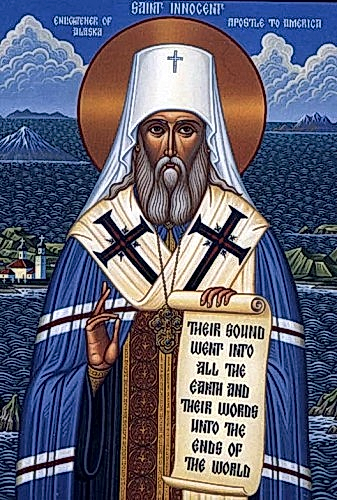
St. Innocent
He was born Ioann Popov-Veniaminov in 1797 in Irkutsk province, Siberia. He lost his father at the age of six, studied at the Irkutsk theological seminary, married, and was ordained a priest before volunteering for distant Unalaska, where he arrived on July 29, 1824. There he spent the next decade and a half in missionary, pastoral, educational, and linguistic work among the indigenous peoples of Alaska — work that would make him one of the most consequential figures in the history of the Orthodox Church in the Americas.
Early life
St. Innocent was born on August 26, 1797, in Anginskoye, Verkholensk District, Irkutsk province, into the family of a church sexton. His father died in 1803, when Innocent was six years old. Despite this, he proved an exceptional student: he entered the Irkutsk theological seminary around 1806–1807 and excelled there. In 1814, the seminary rector gave him the surname "Veniaminov" in honor of the recently deceased Bishop Veniamin of Irkutsk — a common practice of the era for students with no established family name. He married in 1817 and was ordained first as a deacon, then as a priest. (saintinnocentchurch.com)
Mission in Alaska
When the Russian-American Company sought a priest willing to serve at Unalaska, no one volunteered. Veniaminov, then a young parish priest in Irkutsk, eventually felt called to go. On May 7, 1823, he departed with his wife, mother, brother, and infant son. The journey took more than a year; he arrived at Unalaska on July 29, 1824. (saintinnocentchurch.com)
Once there, rather than keeping himself apart, he lived among the Unangan people, learned their dialects, built a church largely with his own hands, and organized schools. He mastered six local dialects and observed the natural world with a scientist's curiosity, recording data on climate, geography, and the customs of the peoples he served. His pastoral rounds required extraordinary travel — by kayak, on foot, and by dogsled — across the Aleutian chain and later southeastern Alaska. In 1834 he was transferred to Sitka (New Archangel), where he extended his linguistic work to the Tlingit people.
Later ministry
When Veniaminov returned to Russia in 1838 to seek approval for his translation work, his wife died unexpectedly. He took monastic vows and was given the name Innocent, after St. Innocent of Irkutsk. In 1840 he was consecrated Bishop of Kamchatka, the Kurile Islands, and the Aleutian Islands — an enormous diocese covering most of the Russian Pacific. He continued to travel its vast extent, visiting communities by ship and dogsled.
In 1850 he was elevated to Archbishop. In 1852, Yakutia was added to his diocese, and he applied his now-practiced method to the Yakut (Sakha) language: a new alphabet, translated scripture and liturgical texts, and local clergy trained to sustain the work. By April 1859, divine services were being conducted in the Yakut language. (saintinnocent.net)
In November 1867 — the same year Russia sold Alaska to the United States — he was appointed Metropolitan of Moscow, the highest position in the Russian Orthodox Church at the time. He served in that role until his death on March 31, 1879. He was canonized a saint by the Orthodox Church in America and the Russian Orthodox Church on October 6, 1977. (OrthodoxWiki)
How did he do it?
The translation work began with the language itself. When St. Innocent arrived at Unalaska in 1824, he immersed himself in the Unangan Aleut dialect, eventually mastering six local dialects. Recognizing that the language had no written form, he devised a Cyrillic-based alphabet for it — a prerequisite for any written scripture or catechism. He did not work in isolation: the Aleut catechism was composed with the help of the local Toien (chief) Ivan Pan'kov, whose knowledge of the language gave the translations their accuracy and natural register. (Library of Congress)
Among the first fruits of this work was his Indication of the Way into the Kingdom of Heaven, a short catechetical guide originally written in Aleut. It was, notably, later translated into Russian — the reverse of the usual direction of missionary literature — and circulated widely among Russian readers. By 1834 he had also produced an Aleut catechism, the first book ever published in an Alaskan Native language. He had also translated the Gospel of Matthew into Aleut in 1828, with these materials eventually published in 1840. (OrthodoxWiki)
His scholarly instincts ran alongside his pastoral ones. He compiled grammar and dictionary materials for languages that had never been written down, and his Notes on the Kolushchan and Kodiak Tongues — a study of Tlingit and other languages of Russian America, with a Russian-Tlingit glossary — was received as a significant event in the European scholarly world. (OrthodoxWiki)
Rather than treating translation as a one-man project, he trained Native and Creole clergy, most notably Iakov Netsvetov, to carry the work forward. This meant the effort outlasted his time in any one place. Later in life, after being consecrated bishop and assigned to Yakutia in Siberia, he applied the same approach to the Yakut language — new alphabet, new translations of liturgical texts and scripture, local collaborators.
Why he is remembered
St. Innocent is venerated as “Enlightener of Alaska and all America” — a title that reflects the breadth of his work across languages, peoples, and decades. He is unusual among missionary figures for approaching indigenous cultures with genuine curiosity and respect rather than imposition: he learned the languages, lived alongside the people, trained local clergy, and produced scholarship that European academics recognized as significant.
The institutions he founded and the clergy he trained continued his work well into the American period after the 1867 sale of Alaska. His influence is traceable in the existence of Orthodox communities throughout Alaska today. He was canonized in 1977, and his feast day is celebrated on March 31 / April 13 (Old Style / New Style). (saintinnocent.net)